Sacred Symbols
Throughout history, humans have used sacred symbols to protect themselves, connect with higher guidance, and understand the universe. These emblems carry layers of meaning, cultural significance, and energetic resonance that remain relevant today. Bringing them into your everyday life can be as simple as wearing jewelry, meditating with a symbol, or placing it in your space to remind you of your intentions.
Evil Eye
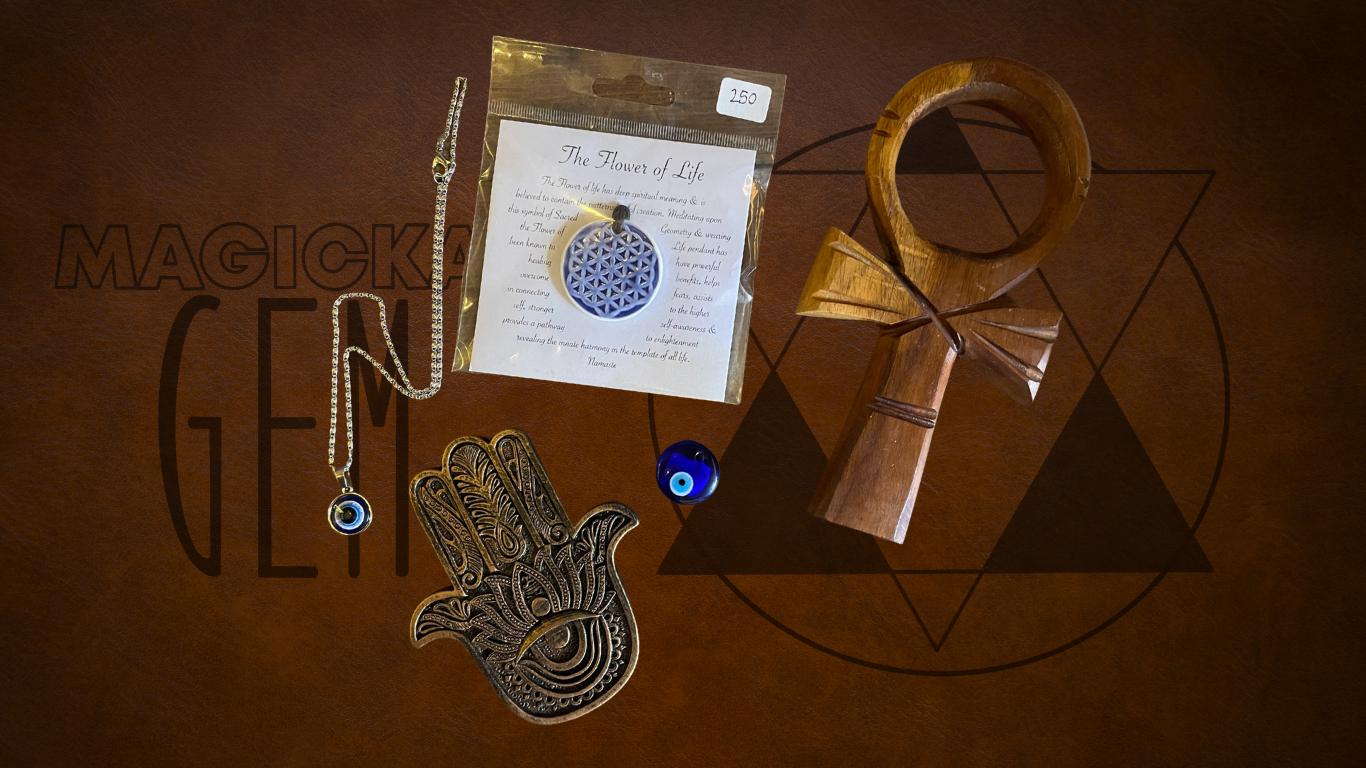
The Evil Eye is one of the oldest and most widely recognized protective symbols. Dating back over 5,000 years to ancient Mesopotamia, it represents the belief that envy or ill-intentions from others can cause harm, and wearing or displaying the symbol creates a shield against such energy. In Greece, it is known as Mati and worn as jewelry, while in Turkey, the Nazar Boncuğu is often hung on walls or doors, and in Latin America, it appears as Mal de Ojo to protect infants. A practical way to work with the Evil Eye today is to carry a small charm in your bag or wear it as a necklace, or place one near your front door to ward off negative energy and remind yourself to keep your personal energy safe.
Flower Of Life
The Flower of Life is a sacred geometric pattern that represents unity, interconnectedness, and the very blueprint of creation. Found carved into ancient Egyptian temples in Abydos, as well as in Chinese and Celtic art, it symbolizes how all life is connected through cycles of energy. In Kabbalah, it is linked to the Tree of Life, showing the structure of divine order. You can use the Flower of Life practically by placing an image of it on your desk, meditating while visualizing the pattern, or drawing it in your journal, which can help you feel aligned, centered, and more connected to the flow of life around you.
Ankh
The Ankh, often called the “Key of Life,” comes from ancient Egypt and represents eternal life, vitality, and the divine flow of energy. Gods and pharaohs are depicted holding the Ankh, symbolizing life force, balance, and the union of masculine and feminine energies. Beyond its spiritual significance, the Ankh can serve as a daily reminder to nurture your energy. You might wear it as jewelry, keep a small Ankh on your altar, or meditate with it to connect with your own vitality and reinforce a sense of balance and personal empowerment.
Merkaba
The Merkaba is a three-dimensional star tetrahedron representing spiritual ascension, light body activation, and the integration of mind, body, and spirit. Its name originates from Hebrew mysticism, where Merkabah means “chariot,” and it was described in Ezekiel’s visions as a vehicle for divine energy. Today, it is used in meditation practices to raise your vibration, activate your light body, and feel more aligned. A practical way to engage with the Merkaba is to visualize it surrounding your body during meditation, imagining it spinning and balancing your energy, which can help you feel grounded yet expanded in your daily life.
Pentagram
The Pentagram, or five-pointed star, represents the five elements—earth, air, fire, water, and spirit—and the balance between them. Its history spans ancient Sumer, Greece, and medieval Europe, where it was drawn on doors to protect against negative forces. In modern pagan and Wiccan traditions, it is used in rituals, spellwork, and protective practices. You can use the Pentagram in everyday life by placing one on your altar, carrying a charm, or drawing it before setting intentions, which helps remind you to maintain balance and harmony within yourself and your environment.
Hamsa Hand
The Hamsa Hand is a universal symbol of protection, healing, and divine guidance. Its origins trace to ancient North Africa, where it was associated with the goddess Tanit, and it later became part of Jewish and Islamic traditions as the Hand of Miriam or the Hand of Fatima. The five fingers symbolize faith, power, and protection, and the open palm wards off negative energies. You can integrate the Hamsa into your daily life by hanging it near your door, wearing it as jewelry, or placing it on your workspace, serving as a gentle reminder that you are guided, protected, and supported in your healing and spiritual journey.
Sacred symbols like these are more than just decorative motifs; they are living tools for protection, guidance, and energetic alignment. By intentionally incorporating them into your life—through meditation, ritual, or simple daily placement—you can tap into centuries of wisdom while making their power practical and personal. Whether it’s carrying the Evil Eye for protection, meditating with the Merkaba, or keeping the Flower of Life in your space for alignment, these symbols help you stay grounded, balanced, and spiritually connected in everyday life.